
Day: December 5, 2024

Why Investing in Quality Road Safety Products MattersWhy Investing in Quality Road Safety Products Matters

Road safety is a critical aspect of modern society, aimed at reducing the number of accidents and ensuring that drivers, passengers, and pedestrians remain safe while on the road. As roads become busier and vehicle speeds increase, there is a growing need for effective safety measures to prevent accidents and minimize harm. This is where road safety products come into play. These products are designed to mitigate the risks associated with road travel, offering solutions that enhance visibility, protect vulnerable road users, and improve the overall safety infrastructure. marine products supplier.

In this article, we will explore the variety of road safety products available today, their uses, and how they contribute to road safety. We will cover products for both drivers and pedestrians, as well as infrastructure improvements that help create a safer road environment.

1. Reflective Road Signs

Reflective road signs are among the most essential safety tools for managing traffic and conveying important information to drivers. These signs are designed to reflect headlights, making them visible even in low-light conditions or during the night. Reflective road signs come in various forms, including speed limit signs, caution signs, stop signs, and directional signs.

They are typically made from materials that reflect light, such as retroreflective sheeting, which bounces light back toward its source, enhancing visibility and safety. In addition to improving driver awareness, reflective road signs also contribute to reducing accidents caused by unclear or invisible road warnings, especially in areas with poor lighting or foggy conditions.

2. Road Markings and Lane Dividers

Lane markings and road markings are crucial elements of road safety products that help in traffic control and guidance. They are typically painted on the road surface to delineate lanes, indicate pedestrian crossings, or designate areas where vehicles should stop. These markings help prevent accidents by maintaining order and preventing vehicles from swerving into dangerous zones.

Lane dividers, which can be physical barriers like concrete walls or flexible plastic poles, serve to separate lanes and prevent vehicles from crossing into opposing traffic. These products are especially important in areas with high-speed traffic or where sudden lane changes may be dangerous.

3. Traffic Cones and Barriers

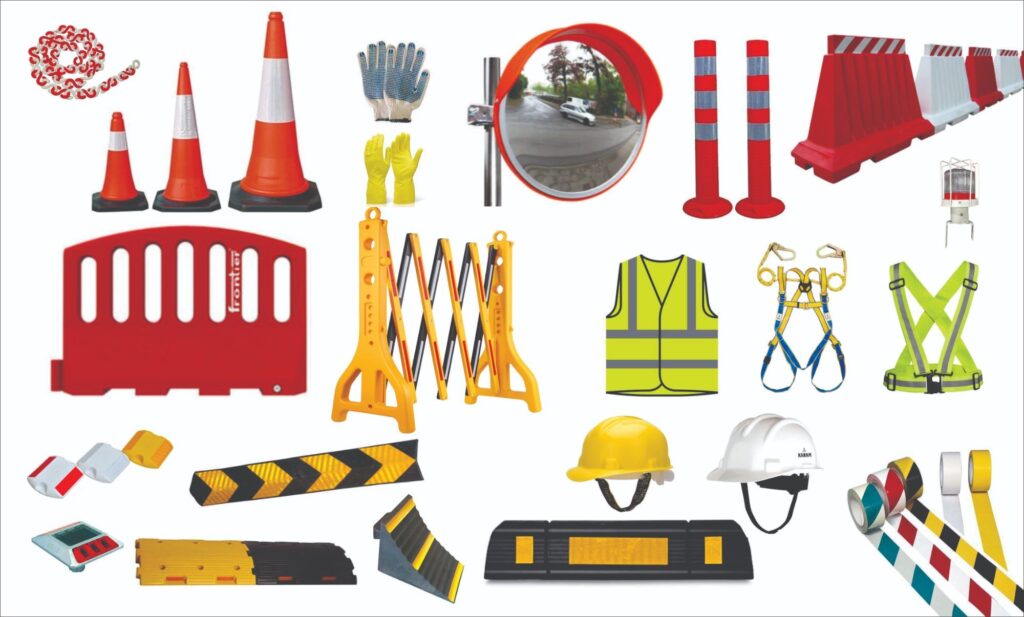
Traffic cones are widely used to direct traffic, close off dangerous areas, or warn drivers of hazards on the road. They are typically made from flexible, lightweight materials that allow them to be easily placed and moved. In construction zones or accident-prone areas, traffic cones help to divert traffic and protect both workers and drivers.

Barriers, whether temporary or permanent, are another road safety product commonly used to separate lanes of traffic, prevent vehicles from entering hazardous zones, or secure construction sites. These barriers are designed to be robust and, in some cases, even crash-resistant to absorb impact and reduce the severity of collisions.

4. Pedestrian Safety Products

Pedestrians are one of the most vulnerable groups on the road, and several products are designed to protect them and ensure their safety. These include:

  • Pedestrian Crosswalk Signals: Crosswalk signals equipped with timers and sound alerts help pedestrians safely navigate busy intersections. These signals are usually paired with warning signs, such as "Pedestrian Crossing," and are equipped with lights to indicate when it is safe to cross the road.
  • Pedestrian Barricades: These barriers are often used to separate pedestrians from traffic, ensuring that foot traffic is kept safe from vehicles. Commonly seen in busy areas like airports, stadiums, and shopping centers, pedestrian barricades help guide people away from roads and traffic lanes.
  • High-Visibility Clothing: Pedestrians can increase their visibility by wearing reflective vests, clothing, or accessories, especially in poorly lit areas or during nighttime. These safety garments are often worn by workers, cyclists, and even pedestrians in high-traffic zones to improve visibility and reduce accidents.

5. Speed Bumps and Speed Humps

Speed bumps and speed humps are physical road safety products designed to slow down vehicles in areas with high pedestrian traffic or where accidents are more likely to occur. Speed bumps are short and steep, requiring drivers to slow down significantly, while speed humps are longer and less severe.

Both types of speed-reducing products are commonly found in school zones, residential areas, and parking lots. By forcing vehicles to slow down, they help prevent accidents and reduce the severity of injuries in the event of a collision.

6. Traffic Lights and Warning Signals

Traffic lights are one of the most common and effective ways to control the flow of traffic and prevent accidents at intersections. These signals, with their red, yellow, and green lights, ensure that vehicles and pedestrians follow a set pattern, reducing the chances of accidents caused by confusion or miscommunication.

In addition to standard traffic lights, various warning signals are used to inform drivers of potential hazards. For example, flashing lights may be used to alert drivers to the presence of school zones, railway crossings, or dangerous curves. These products increase awareness and help mitigate risks in high-risk areas.

7. DUI Checkpoints and Alcohol Safety Products

Driving under the influence (DUI) is a leading cause of road accidents, and DUI checkpoints are an important tool for ensuring drivers do not get behind the wheel while intoxicated. These checkpoints, which often include breathalyzer tests, aim to deter impaired driving and reduce the number of accidents caused by alcohol or drugs.

In addition to roadside checkpoints, there are also personal breathalyzers that individuals can use to test their own blood alcohol levels before driving. These products are crucial in promoting responsible driving and reducing DUI-related accidents.

8. Vehicle Safety Products

For those behind the wheel, various safety products are available to increase protection in the event of a crash. Some of these products are built into the vehicle, while others are optional add-ons that drivers can install to further protect themselves and their passengers. Key vehicle safety products include:

  • Seat Belts and Airbags: These are standard safety features in almost all vehicles today. Seat belts help secure occupants during sudden stops or crashes, while airbags deploy to cushion the body from impact.
  • Crash Barriers and Bumpers: Vehicle bumpers and crash barriers are designed to absorb the energy from impacts, reducing the severity of collisions.
  • Blind Spot Detection and Lane Departure Warning Systems: These modern technologies use sensors and cameras to alert drivers when there is a vehicle in their blind spot or if they are unintentionally drifting out of their lane.

9. Road Safety Education and Awareness Products

In addition to physical products, road safety awareness is equally important. Road safety education products, such as books, posters, and educational programs, help inform the public about the importance of safe driving and pedestrian behavior. Campaigns often focus on issues like seatbelt use, distracted driving, and the dangers of speeding.

These awareness initiatives play a crucial role in changing behavior and preventing accidents by encouraging responsible actions from road users.

10. Road Safety for Cyclists

Cyclists face unique challenges on the road, and several safety products are designed to protect them. These include:

  • Bike Helmets: Wearing a helmet significantly reduces the risk of head injuries in the event of an accident.
  • Reflective Gear and Lights: Cyclists can improve their visibility by using reflective clothing or attaching lights to their bikes. These products help cyclists stay visible, especially in low-light conditions or at night.
  • Dedicated Bike Lanes and Barriers: In urban areas, separate bike lanes and physical barriers provide cyclists with a safer space away from vehicular traffic.

Conclusion

Road safety products are indispensable for creating safer roads and protecting those who use them. From reflective signs and lane dividers to pedestrian safety measures and vehicle protection systems, these products work in tandem to reduce the risk of accidents and save lives. Road safety is a shared responsibility, and the use of these products can significantly enhance safety for all road users. Investing in road safety infrastructure and products is not just a legal requirement but a moral imperative to ensure that everyone, whether driving, walking, or cycling, can travel safely.

4o mini


20 NEW SUGGESTIONS FOR CHOOSING AI STOCK TRADING20 NEW SUGGESTIONS FOR CHOOSING AI STOCK TRADING

Ten Top Tips For Evaluating The Risk Of Underfitting And Overfitting Of An Ai Predictor Of Stock Prices
AI stock trading predictors are susceptible to underfitting and overfitting. This can impact their accuracy, and even generalisability. Here are 10 strategies to analyze and minimize the risk of using an AI prediction of stock prices.
1. Analyze Model Performance Using Sample or Out of Sample Data
The reason: High accuracy in the sample and poor out-of sample performance may indicate overfitting.
How do you determine if the model performs consistently across both sample (training) and out-of-sample (testing or validation) data. A significant performance decline out of sample indicates a high risk of overfitting.

2. Verify that the Cross Validation is in place.
The reason: Cross validation is a way to ensure that the model is adaptable to other situations by training it and testing on multiple data sets.
What to do: Confirm that the model employs k-fold cross-validation or rolling cross-validation particularly in time-series data. This can help you get an accurate picture of its performance in real-world conditions and determine any potential for overfitting or underfitting.

3. Assess the Complexity of Models in Relation to Dataset Size
Overfitting is a problem that can arise when models are too complex and too small.
How? Compare how many parameters the model is equipped with to the size dataset. Simpler (e.g. tree-based or linear) models are typically preferable for small datasets. Complex models (e.g. neural networks, deep) require extensive data to prevent overfitting.

4. Examine Regularization Techniques
The reason: Regularization decreases overfitting (e.g. dropout, L1 and L2) by penalizing models that are excessively complicated.
What to do: Ensure the model employs regularization that is suitable for its structural properties. Regularization is a method to constrain the model. This helps reduce the model’s sensitivity to noise and enhances its generalizability.

Review feature selection and Engineering Methodologies
What’s the reason? By adding unnecessary or excessive attributes The model is more prone to be overfitting itself since it might learn from noise but not signals.
What should you do to evaluate the selection of features and ensure that only relevant features are included. Principal component analysis (PCA) and other techniques to reduce dimension can be employed to eliminate unnecessary features out of the model.

6. Consider simplifying tree-based models by using techniques like pruning
Why: Tree models, such as decision trees, are susceptible to overfitting if they become too deep.
How do you confirm if the model can be simplified using pruning techniques or any other technique. Pruning eliminates branches that cause more noisy than patterns, and also reduces overfitting.

7. The model’s response to noise
Why are models that overfit are highly sensitive to noise and small fluctuations in data.
To determine if your model is robust Add tiny amounts (or random noise) to the data. Then observe how predictions made by the model change. Models that are robust must be able to deal with small noise without affecting their performance, whereas models that are overfitted may react in an unpredictable way.

8. Find the generalization error in the model.
The reason: Generalization errors show how well models are able to anticipate new data.
Determine the differences between training and testing mistakes. An overfitting result is a sign of. But the high test and test error rates indicate underfitting. Try to find a balance in which both errors are minimal and similar in importance.

9. Learn more about the model’s learning curve
Why: Learning Curves indicate the degree to which a model is either overfitted or underfitted by revealing the relationship between size of the training set and their performance.
How do you plot the learning curve (training and validation error against. size of the training data). In overfitting, training error is minimal, but validation error is still high. Underfitting shows high errors for both. The graph should, ideally display the errors decreasing and convergent as the data increases.

10. Examine the stability of performance across different Market Conditions
What is the reason? Models that are prone to overfitting may work well in an underlying market situation however they will not work in other situations.
How: Test your model by using different market conditions like bull, bear, and sideways markets. Stable performance in various market conditions indicates that the model is capturing strong patterns, rather than being over-fitted to one regime.
These techniques can be used to evaluate and mitigate the risks of overfitting or underfitting in an AI predictor. This will ensure the predictions are correct and valid in real-world trading environments. Take a look at the best published here for more info including investment in share market, chart stocks, ai stock trading, buy stocks, ai trading, ai for trading, best ai stocks to buy now, openai stocks, stock market ai, ai for stock trading and more.

Ten Top Tips To Evaluate The Nasdaq Composite By Using An Ai Prediction Of Stock Prices
Analyzing the Nasdaq Composite Index using an AI stock trading predictor requires understanding its unique features, the technological nature of its constituents, and how well the AI model is able to analyze and predict the movement of the index. These are the top 10 methods to evaluate the Nasdaq Index by using an AI-based stock trading predictor.
1. Understanding Index Composition
The reason is that the Nasdaq Composite is a concentrated index, it has a the largest number of stocks in sectors such as technology, biotechnology or internet.
How to: Get familiar with the most influential companies in the index. Examples include Apple, Microsoft, Amazon and others. The AI model will be better able to predict movements if it is capable of recognizing the impact of these companies on the index.

2. Include specific sectoral factors
Why: The Nasdaq’s performance is greatly dependent on technological trends and sectoral events.
How to: Include relevant variables to the AI model, like the performance of the tech sector, earnings reports or trends in software and hardware industries. Sector analysis enhances the predictive power of a model.

3. Use Technical Analysis Tools
What are the benefits of technical indicators? They can help you capture the market sentiment and price trends of a volatile index like Nasdaq.
How: Integrate technical analysis tools like Bollinger Bands (moving averages) and MACDs (Moving Average Convergence Divergence), and moving averages, into the AI. These indicators are helpful in identifying signals of buy and sell.

4. Keep track of the economic indicators that Impact Tech Stocks
The reason is that economic factors like interest rates, inflation and employment rates could influence tech stocks as well as Nasdaq.
How do you integrate macroeconomic variables that are relevant to the technology sector, including technology investment, consumer spending trends, and Federal Reserve Policies. Understanding these connections can help enhance the accuracy of predictions made by the model.

5. Evaluate the Impact of Earnings Reports
What’s the reason? Earnings reports from the major Nasdaq companies can result in significant price fluctuations and affect index performance.
How to: Ensure that the model is following earnings calendars and that it adjusts its forecasts based on the dates of earnings releases. Analyzing the historical responses of prices to earnings reports will also increase the accuracy of predictions.

6. Use Sentiment Analysis to Invest in Tech Stocks
Why is that investor sentiment can have a significant impact on the value of stock and performance, particularly in the tech industry, where trends can be swiftly changed.
How to: Include sentiment analysis into AI models that draw on financial reports, social media as well as analyst ratings. Sentiment metrics may provide more context and improve predictive capabilities.

7. Conduct Backtesting with High-Frequency Data
The reason: Nasdaq volatility is a reason to examine high-frequency data on trades against forecasts.
How to use high-frequency data to test backtest AI prediction models. It allows you to validate the model’s ability to perform across a variety of market conditions.

8. Analyze the model’s performance during market corrections
Why is that the Nasdaq could undergo abrupt corrections. It is essential to be aware of the model’s performance when it is in a downturn.
What can you do to evaluate the model’s performance over time during significant market corrections or bear markets. Stress testing can help reveal the model’s resilience and its ability of mitigating losses in volatile times.

9. Examine Real-Time Execution Metrics
Why? Efficient execution of trades is vital for capturing profit, especially with a volatile index.
How to monitor in real-time the performance of metrics like fill and slippage. Check how your model predicts the best entries and exits to trade on Nasdaq to ensure that executions match predictions.

10. Review Model Validation through Out-of-Sample Testing
The reason: Testing the model with new data is crucial to make sure that it is able to be generalized well.
How do you conduct thorough tests outside of sample with the historical Nasdaq data that were not used for training. Comparing actual and predicted performance will ensure the model is accurate and robust.
You can test the ability of an AI trading predictor to accurately and reliably analyse and forecast Nasdaq Composite Index movements by using these suggestions. See the recommended playing stocks tips for site tips including incite ai, stock market ai, investment in share market, ai stock trading app, stock prediction website, invest in ai stocks, ai copyright prediction, ai stock, ai trading software, investing in a stock and more.